The Face of the Fight for Freedom
This woman in her red coat, her 6'3" brother and her Ninja husband are the faces of the fight for freedom in China and the rest of the world. She fights for her right to her home, and stands nearly alone to confront the wrecking ball and China's statist bureaucracy.
I cheer her, and the fact that her voice can be heard. China has a long way to go. China has come a long way.
Tuesday, March 27, 2007

Saturday, March 10, 2007
Comments on the Electric Utility “Deregulation” Mess
Recently, I received the following (edited) question regarding the choice of electricity supplier in the state of New Jersey. The question is applicable for anyone who has a “choice” in any of the states that “deregulated” their electric utilities in the 1990s. These include California, Connecticut, Illinois, Massachusetts, Michigan, New Hampshire, New Jersey, New York, Ohio, Pennsylvania, Rhode Island and Texas. The details of the deregulation plans vary by state, but all of them, to varying degrees, offer or did offer customers a choice of electricity supplier. Most of these states also mandated that utilities in their state had to divest all or a portion of their power plants. My answer is applicable to all of these states and, in important respects, to the entire country. PSEG is Public Service Enterprise Group, which provides electricity to parts of New Jersey.
***
Hi GB,
I hope this email finds you well. I've lately become consumed with what I pay PSEG so I requested alternative electric energy supplier options (they pretty much have a monopoly on distribution).
Of the list of 19, just 2 offer residential service to my zip code. My question to you is: does the residential customer really have any choices? It seems all of the options are for businesses. (With the amount of research I've done on this topic today, this may turn out to be an article in the newsletter I publish! But I need to check my facts with you first.)
To their credit, PSEG does offer many comprehensive programs, tips, and arrangements to "help pay", lower, and generally help make paying them less of a burden, however, I can't help feeling like I'm just not getting the choices I'm supposed to get in a dereg'd marketplace.
Any thoughts you can share with me on this will help alleviate my frustrations... thanks!
A Reader
***************************************************
My answer:
Dear Reader,
As for the question in your email, residential customers don’t really get much of a choice much of the time. I suspect that any deal you are offered probably doesn’t present much savings over PSEG.
As for why, it is quite complicated to answer. The simplest answer is that the electric industry was never really deregulated, so deregulation can’t be blamed for what you are observing with regard to residential choice of electricity supplier.
Consider that “deregulation” in the case of utilities involved something good (allowing entities other than utilities to build more power plants) and quite a lot that was not good and “re-regulatory” in nature. The good thing, allowing others to build power plants, should lower prices over time because newer and more efficient plants will get built. However, that is true only if both utilities and non-utilities are truly free to build plants. Being truly free would mean that they can: (1) charge whatever they want for power produced from those plants, (2) locate them in the best locations, wherever they can buy land, and (3) build the plants using whatever they think is the best technology.
None of those things are true today. I’ll briefly address each of them:
(1) Price Maximums = Expensive Power. Price maximums are set by federal and regional regulators in the wholesale power market. Capped prices mean capped profits and a reduced desire for companies to build power plants. If fewer new power plants get built, prices will remain high because electricity continues to be made with old, inefficient plants.
(2) You Can’t Build It Here. Local zoning rules, land use restrictions, environmental rules, and the “NIMBY” reaction of local politicians to a power plant in their local area make it extremely difficult to locate new plants in the areas where they are most urgently needed, such as near urban areas where the customers are. “NIMBY” stands for “Not In My Back Yard.”
(3) Using the Best Technology Is Forbidden. The cheapest technology for a new “base-load” power plant, i.e., one that is designed to run 24/7, 365 days a year, is nuclear. Base load plants are the work-horse plants on the grid. They supply most of the electricity that you use. Unfortunately, nuclear energy in America has been made prohibitively expensive through unnecessary safety rules imposed after Three Mile Island. No one has died from exposure to nuclear radiation in that accident or any other accident anywhere in the modern, Western industrialized world (which the Communist government responsible for Chernobyl was not; no Western engineer would have built a nuclear power plant without a containment vessel, which the Soviets did). Despite nuclear energy's exemplary safety record, arbitrary safety regulations have made nuclear energy almost prohibitively expensive.
So, faced with the rules & regulations embodied in points 1-3, the electric industry remains very highly regulated in a manner that results in high electricity prices.
The other part of the answer is the re-regulation that was part of “deregulation”. Sound confusing? What makes it confusing is that when the “deregulators” thought they were deregulating, they were actually re-regulating the industry by imposing an artificial industrial structure on the utilities. The “deregulators” developed the mistaken belief that they knew better than the utilities what business structure they should have. So, they broke apart the utilities, much in the same way AT&T was broken up by deregulators in 1984 (that action was also a mixed bag of “re-regulation” and partial deregulation, but that is another discussion). They forced the utilities to sell their power plants, and then they forced the utilities to allow others to use their distribution wires to deliver electricity to customers. That is why someone other than PSEG can “sell” you power even though they do not own the wire that delivers it to your house. Instead, PSEG owns the wire and you pay PSEG to have that other company’s power delivered over PSEG’s wire to your house. It is similar to how competing long distance companies would use Verizon’s local phone lines to provide you with long distance service.
The result of the artificial manipulation of the utilities’ corporate structures and business practices is that they operate in a manner less friendly to customers. Until the pseudo-deregulation of the 1990s, utilities were vertically integrated. They owned their power plants. That enabled them to offer power at predictable prices. However, by artificially separating utilities from their power plants, they were forced to buy power partially or completely in the wholesale power markets. In itself, that might have worked out okay, but regulators also forced the utilities to buy power under relatively short-term contracts. As a result, short-term price fluctuations get transmitted to customers.
To summarize the point about re-regulation, the artificially broken-up structure of utilities makes them less economically efficient, with the result that power prices are both higher and more volatile to customers.
Sound complicated? It is. Is it deregulation? No. Is it an unholy mess? Indeed, it is.
I will give a hint of what a proper government policy toward utilities should be: hands-off or laissez faire. In particular, utilities should get no legal monopoly protection, which they still have. Anyone should be free to start up a business selling electricity to customers. If this were permitted, we would likely see a lot of technological and business structural innovation, such that utilities would look a lot different than they do today. For example, real estate developers may build “mini-utilities” with small power plants to provide power to residential sub-divisions. Large commercial buildings may find it is economical to self-generate using gas-fired generators in their basement. It is even conceivable that individual homes may be powered by micro-generators the size of air conditioners. Large utilities are likely to still exist, but they will compete with each other, with the customer benefiting from lower rates. Or, large utilities may function largely as back-up sources of power to whom electricity customers would pay a fee for that service.
All of this innovation (and other types that remain to be conceived by a future entrepreneur) could happen if utilities were truly deregulated and politicians stayed away from the business of providing electricity. None of it will happen under the current structure, which mixes a few, tentative measures of market freedom with a whole lot of contradictory government control. Utilities today are arguably the most regulated private industry in the country, with a welter of overlapping local, state and federal authorities all having a hand in how they are run. With that many cooks in the kitchen, is it any wonder that the pies they make taste so awful and cost so much?
Bottom line for you personally: without knowing the details of the offers from other electricity suppliers, I suspect you are better off, in terms of hassle and probably even money, by staying with PSEG!
Bottom line for the country: we all pay too much for power and will continue to do so until true deregulation occurs. But, before that can happen, people need to draw true conclusions about the ersatz-deregulation that has been attempted already.
Sincerely yours,
GB
P.S. – There are other aspects to this complicated problem. One of them (to be discussed) is the price and profit controls on electric transmission lines that prevent enough new transmission lines from being built. The result is that the electric grid is ossified and subject to blackouts, and power is too expensive.
Tuesday, February 27, 2007
Private vs. Public
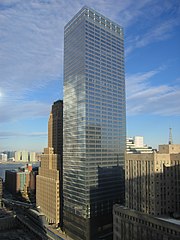
7 World Trade Center, destroyed on 9/11/01. Today it is a shining tower that is 80% leased. Top rents are $80 per square foot, well above the $50 per square foot its critics said it would never get.
Nos. 1-6
What is the difference? The former is owned and operated by a private developer, Silverstein Properties. The latter is owned by the Port Authority of New York and
What is the lesson? Draw your own conclusions.
Source: New York Post, "Moody's Takes More", 2/27/07
Tuesday, February 13, 2007
Funding the Enemy
The United States has already paid $1.026 billion in ransom to the North Koreans in order to stop them from building the nuclear bomb. That was the price tag from 1995-2003 of President Clinton's "Agreed Framework" plan. Under that plan, negotiated in 1994, we paid the North Koreans food, fuel oil and in two light-water nuclear reactors to stop building the nuclear bomb. We helped them build nuclear reactors in exchange for stopping the building of the nuclear bomb. That is kind of like helping someone make dynamite in hopes that they don't build bullets.
You can read all about it here in a report prepared by the Congressional Research Service, a bureau of the U.S. Congress.
What did we get in return for the $1.026 billion? The answer occurred on October 9, 2006, when North Korea conducted a test explosion of what may have been a nuclear bomb.
Now, President Bush has agreed to give an additional $400 million of fuel oil and electricity... in exchange for what? The North Koreans have agreed to shut down current bomb-making efforts. What about the prior nuclear bombs they may have already made and the weapons-grade uranium they have stockpiled? We will leave that to a future negotiation to determine how much additional ransom we should give the North Koreans to turn that over to us.
What is to stop the North Koreans from lying and continuing their production of more nuclear bombs, just like they did in 1994 when President Bill Clinton and Secretary of State Madeleine Albright negotiated the first ransom payment? Nothing.
President Bush once called North Korea part of the Axis of Evil. Today he is paying money to a key member of that Axis. They will use it to build more nuclear bombs. We, the citizens of the United States, are paying for construction of the bombs that may one day be exploded over our cities.
***
For a pictorial representation of how the North Koreans have played us, look here.
Friday, February 09, 2007
Mikhail Khodorkovsky: Victim of the New
On Monday of this week, the Russian Prosecutor General levied new criminal charges against Mikhail Khodorkovsky. The new charges mean it is likely that Khodorkovsky will remain imprisoned at a Siberian labor camp past 2008, when he is currently up for parole. Khodorkovsky has been incarcerated since July 2003 after being charged and then convicted of tax evasion, stealing and sundry similar charges.
What is really going on here?
Russian President Vladimir Putin, a former KGB officer, has been ruthlessly stamping out all forms of opposition. He is re-nationalizing companies and closing down independent television stations and newspapers. He now appoints provincial governors who used to be elected. While he has been in office, more than 40 journalists have been assassinated. Under his watch, none of these crimes has been prosecuted. He is confiscating foreign business interests in
When he was an active KGB officer serving in the
Putin is going out of his way to make sure that a man like Mikhail Khodorkovsky spends more time in the gulag. Why is he such a threat?
Men like Khodorkovsky are a threat to dictators everywhere because they are independent. Khodorkovsky was a double threat to the dictator, a man independent in his thinking and independently wealthy. Khodorkovsky was not just the wealthiest man in
All of the business steps Khodorkovsky took resulted in Yukos’ oil production growing at a nearly 20% annual rate during the last three years before his arrest and the Russian government's confiscation of Yukos. The proof of his Western managerial style was in these results.
Based on the public information available, Khodorkovsky’s actions are those of a highly competent, intelligent and successful business executive. His rise was a remarkable sign that
One of the charges against Khodorkovsky is that he unfairly acquired the assets that formed the base of Yukos during the corrupt privatizations of the 1990s. This may be true, but it is irrelevant. In a Communist society, no one “owns” the industrial plants, equipment and resources. The state was not the owner; it was the confiscator of property that had been formerly owned by private individuals prior to the Revolution. Such property would lie fallow until men like Khodorkovsky stepped forward to make it valuable. This process is similar to the appropriation of land by the Homesteaders in the
That men such as Khodorkovsky stepped forward to appropriate such property, and make it far more valuable than it had ever been under the Communists, we should all be thankful. By doing so, he created wealth that he enjoyed and all those who did business with him enjoyed. That wealth was created, after having been dissipated by the Communists before. By doing so, he also helped bring the rule of law through modern business practices and accounting standards to
Stated in simplest terms, the proof of Khodorkovsky’s moral right to the property that formed the base of Yukos is the fact that he made it productive. He was a Homesteader.
Moral leaders in the West have said little about Khodorkovsky’s imprisonment (under horrible conditions, he was recently slashed by a fellow inmate). In the United States, leaders such as President Bush, who himself excoriated American businessmen and imposed punishing new rules on them such as Sarbanes-Oxley, have been incapable of taking a moral stand in support of Khodorkovsky. Instead, Bush, speaking of Putin, utters such grotesque inanities as, “I looked the man [Putin] in the eye. I found him to be very straightforward and trustworthy. // I was able to get a sense of his soul; a man deeply committed to his country and the best interests of his country.” With statements like that backing him up, it is no wonder that Putin feels morally empowered to stamp out the independent minds in
I wish Mikhail Khodorkovsky well. May justice prevail.
Sunday, February 04, 2007
Mass Hysteria
A recent HBO documentary chronicles a road trip through the Bible Belt. Friends of God: A Roadtrip with Alexandra Pelosi shows the narrator as she visits a truck stop where nightly prayer sessions are held; as she interviews a man who erects gigantic white crosses all over the South; as she chronicles brain-washing sessions for children where overweight hucksters explain the truth of Creationism, and how man could not be evolved from monkeys; as she visits a family of ten children where the pregnant mother describes how she used to want to be a doctor, but now glories in her holy duty of procreating for Christ. The narrator attends church meetings where well-known national ministers such as Jerry Falwell tell his congregation to vote for candidates who uphold Christian values such as anti-abortion. She shows us Christian comedians and Christian rock stars, and Christians who proudly declare themselves "soldiers for Christ" at "Battle Cry" rallies.
She shows us mass hysteria.
How much of a threat is it? Is it growing, or declining? What would these people do if they gained complete political power? What would happen to atheists, agnostics, gays, and members of every religious sect other than fundamentalist Christianity?
The ideas are so ridiculous, the worship is so... cheesy, that I find it hard to take seriously. Hopefully, a majority of Americans will always feel as I do. Hopefully, a majority of Americans will respect science. Hopefully, a majority of Americans will uphold the separation of church and state. Hopefully, a majority of Americans will stand for religious freedom, the right of people of different faiths -- and no faith at all -- to live together peaceably. Hopefully, a majority of Americans do not want government legislating personal morality.
These Christian true-believers are laughably small in stature. They take the Bible literally. They believe the earth is 6,000 years old. They believe God created man in His image and that evolution is false. They are hypocrites and guiltily engage in the sexual practices they say are evil.
As they battle for Christ, they tell us they would outlaw abortion. They would ban certain sex practices and homosexual acts. They would use government money to fund their causes in violation of the First Amendment. All of this they have admitted.
And if they really got all of the political power they crave, what would their true colors be?
Tuesday, January 30, 2007
Nuclear Power: Hated by Environmentalists
The environmentalists
If the Nuclear Regulatory Commission were shut down, and all federal and state regulations were eliminated on nuclear power plants (and all other forms of electricity generation), I suspect that we would generate the majority of our electricity from nuclear power plants. Nuclear power has an inherent economy of scale because a very tiny amount of material can produce a huge amount of energy. Nuclear energy is very concentrated. This means that the cost of handling uranium and disposing of waste is very small in comparison to the amount of energy produced.
Contrast this with coal, where many 100-car-long trainloads of coal are needed to produce the amount of electricity that could be produced in a couple softballs
Only a wealthy, technologically advanced society can cheaply deploy a technology as advanced and beneficial as nuclear energy. Nuclear energy is clean and would be very cheap if it were not regulated. Yet all of the regulations on power generation -- including the pollution rules on fossil power -- just make our economy that much poorer, and less able to afford something as magnificent as nuclear power. So, ironically, by attempting to regulate in order to prevent pollution, such regulations have the opposite effect of making us poorer and therefore more likely to use polluting technologies, such as fossil fuels.
This point may not seem obvious, but observe that the worst polluting societies are the emerging
As a final tidbit on nuclear power, I remember reading about an Alaskan village that wanted to install a tiny underground nuclear reactor for electricity. They believed it would be far cheaper to generate electricity through nuclear fission than it was to burn fuel oil that had to be arduously transported at great expense to their small village. I spoke to a nuclear engineer who told me that it was feasible to make such small nuclear reactors, but you would have to wait for "hell to freeze over" before the regulators would permit it. Given how much those Alaskan villagers have to pay for electricity, and how low they probably set their thermostats to save money, I imagine that they are already living in their frozen little hell.
Monday, January 29, 2007
Señor, Where
At the risk of sounding drunk on the ethanol story, here is another unintended consequence of that boondoggle. The excellent Latin American editorial columnist Mary Anastasia O
This unlikely of scenarios requires a "perfect storm" of government intervention on both sides of the border. It hasn’t happened yet, but warning signs of the coming storm are visible. The first of these, the
Tortillas, made from corn, are a ubiquitous and tasty staple of Mexican cuisine. Spanish conquest, wars, revolutions, and socialist economic policies could not dislodge the tortilla from its central place in Mexican cooking. However, a perfect storm combination of artificially high corn prices caused by the
How could this happen?
However, Mexican corn farmers are free to export their corn if the global price is high enough. Guess where the big new demand for corn is pushing global corn prices to record levels? The new demand for corn is coming from the
Now, there can still be enough tortillas on the street corner, albeit at much higher prices, if the price mechanism is not interfered with. Tortilla prices will simply rise to reflect the higher prices of corn.
But in
***
Note: Edited last paragraph for clarification and style on 1/30/06.
Tuesday, January 23, 2007
Drunk on Ethanol
In economics, there is the principle that capital will flow to its highest use. In other words, if you can make a profit doing something, you will find backers for your idea.
That principle is forgotten in what is shaping up to be a monumental boondoggle. I am referring to the government's massive program to promote the production of ethanol as a substitute for gasoline. The motives for this program are several. The stated one is that it will improve our security by reducing our dependence on Middle Eastern oil. That is unlikely. But the less frequently mentioned reason is that it is a sop to farmers. It is seen as yet another in the long, 75-year history of government programs that subsidize farmers: most ethanol is made from corn.
Already, corn farmers are feeling the money-rush of Bush's 2005 expansion of government support for ethanol production. Prior to 2005, ethanol producers benefited from favorable tax treatment, in particular an exemption from the 51 cents-per-gallon federal tax on gasoline. Despite that relative advantage, ethanol production for fuel had grown modestly. The Bush-sponsored Energy Policy Act of 2005 went much further. That Act made the tax break permanent, imposed a tariff on imported ethanol, and called for the first-ever requirement that gasoline producers incorporate a quantitative target of ethanol into a gasoline-ethanol blend to be used by cars.
The effect of the triple-punch of favored tax status, tariffs and production quotas has been huge. In just the past two years, the number of ethanol plants in operation has doubled to 110. Half of these are owned and financed by farmers. In 2006, 5.4 billion gallons of ethanol were produced as producers labored to meet the quota.
Today, President Bush proposed more than quadrupling the bet on ethanol by raising the mandatory production target for gasoline substitutes, primarily ethanol, to 35 billion gallons from the current 7.5 billion target. That represents more than 20% of current gasoline consumption.
Such a massive increase in ethanol production, because it largely depends on corn, will predictably raise the price of corn. It is already happening. Higher corn prices mean higher prices for everything that is made from corn, including livestock feed and high fructose corn syrup. (High fructose corn syrup is itself a market that was largely created by government intervention, in this case the near-prohibition of sugar imports.) This means higher prices for meat and the large number of food products that are sweetened with high fructose corn syrup such as soft drinks. American corn exports will also suffer as they are slowly priced out of the international market.
All of this will have a sad and predictable end. Eventually, the subsidies will be curtailed and/or the price of oil will fall to such a level that ethanol will become unprofitable even with the subsidies. A majority of the plants that produce ethanol will be shut down. Farmers who invested in the ethanol plants will lose their investments. Farmers who plowed under their soybeans and grain fields to plant more corn will get hammered. And, at the end of the day, we will discover that the entire effort did not make a dent in our imports of oil, which will be greater than ever. (The latter acknowledges that production of ethanol may actually consume more energy than it produces. If that is true, increasing ethanol production may result in greater imports of oil. Even if it is not true, it is unlikely that ethanol production will result in any significant energy savings. See the first link above.)
A lot of investment, both direct investment through venture capital and government subsidies, and indirect investment through the diversion of resources from other uses, will be wiped out.
All of this is easy to predict because the government's sponsorship of an ethanol program violates a basic principle of capitalism. That principle is that capital flows to its highest and best uses, if it is left free. If ethanol were practical, no subsidies would be necessary. Because subsidies are necessary, it is not practical. Once the impracticality of ethanol is revealed in the marketplace and the subsidies end, the entire pseudo-industry crashes down.
Government management of the economy never works. There are no examples of legitimate industries requiring subsidies, and no examples of subsidized industries that are legitimate, to the extent they are subsidized. All subsidies destroy wealth. Today, everyone -- farmers, politicians and international security "experts" -- is drunk on ethanol. Tomorrow, all of them -- and all of us who were forced to pay for this boondoggle through higher taxes and prices for corn -- will wake up with a hell of a hangover.
* * *
UPDATE 1/25/07: The good times at the ethanol punch bowl may end sooner than a lot of soon-to-be-unhappy investors and farmers may realize. The Dow Jones Newswire reports:
"Speaking... at the World Economic Forum, [U.S. Energy Secretary] Bodman also said he does not see a 51-cent-a-gallon subsidy to U.S. farmers remaining in place beyond 2010 or an import tariff of 54 cents a gallon on ethanol beyond 2008. 'The idea is that at some point in the future all these technologies need to stand the test of the free market,' Bodman said."
Perhaps Bodman has been reading up a little on how ethanol may consume more energy than it saves, corrodes automobile engines, raises the price of corn products... Well, you know the story. All subsidies end. But before they do, they cause a lot of damage. That is why Bodman is wrong on one key point. All technologies should stand the test of the free market all of the time, not just at some point in the future.
Divided and Conquered
A Wall Street Journal article today ("In Climate Controversy, Industry Cedes Ground") shows how American industry is capitulating on the global warming issue. Captains of industry are falling all over themselves to proclaim their eagerness for controls on carbon dioxide emissions... as long as the controls hit other industries more than their own.
Duke Energy CEO James Rogers, long known as an "environmentalist" CEO, despite his helming some of the largest carbon dioxide producing coal-burning utilities in the country, best captures this attitude, when he said, "If you
Rogers is doing his best to make sure that utilities other than his will be on that menu. He supports one form of carbon dioxide controls that will favor coal-burning utilities like his own and disadvantage, on a relative basis, other utilities that emit less carbon dioxide. Needless to say, the CEOs of those other utilities support their own carbon dioxide controls that especially favor their companies, in relative terms.
The article points out that the automobile manufacturers favor controls on the utilities and oil companies, and the oil companies favor controls on the automobile manufacturers and utilities. The utilities just want to make sure all sectors of the economy face controls, so that their industry is not singled out.
Amidst all this jockeying to beggar-thy-neighbor, almost no one is asking why carbon dioxide should be controlled at all. One of the only companies that was doing that, ExxonMobil, just threw in the towel after being threatened by a couple of senators [hat tip: Gus Van Horn].
One thing is clear amidst all this jockeying is that the beggars at the table will soon discover that they are the only ones on the menu.
Monday, January 15, 2007
The American Samoa Exemption
The new legislation to increase the minimum wage reportedly will maintain the "American Samoa Exemption", a policy that has permitted employers on the U.S. island chain to pay workers far below the U.S. mainland minimum wage.
The Exemption reveals the immorality and impracticality of the minimum wage.
The exemption of American Samoa from the minimum wage is an acknowledgement that the minimum wage forces some people to endure a wage of zero, i.e., far below the "minimum". No one can legislate productivity, and if productivity means some worker's labor is worth less than a minimum wage, that worker will not be hired. His job will essentially be outlawed.
Productivity in that part of the world is much lower than in the mainland United States, and therefore prevailing wages are much lower. If the U.S. minimum were enforced there, it would cause not just a little unemployment, like it does in the mainland U.S., but widespread unemployment. In fact, it would be completely unenforceable.
The existence of the American Samoa exemption is an unpleasant reminder to everyone who votes for the minimum wage -- Democrats, Republicans and President Bush -- that it destroys jobs, and that the higher it is set, the more jobs it destroys. Furthermore, the people who suffer the most from the minimum wage are those who are young and beginning their working years, and those with the least education and skills. These are precisely the people the Democrats pontificate about wanting to help.
The wider issue is that the Democrats don't want to help the poor; they want the poor. In fact, they want as many people as possible to be poor, because it creates a dependent class of modern-day serfs who believe that the Democrats are their salvation. By keeping a large class of people poor, unemployed and dependent on government hand-outs, Democrats corral their votes. It is an ugly form of "vote-buying" that trades on human misery. The minimum wage is part of that.
As for the hapless Republicans who vote for the minimum wage, they "just don't get it". They think that by placating their opposition, the Democrats, they will somehow keep their grip on political power. In fact, their policy does nothing but strengthen the opposition by endorsing their moral premises, and enacting their laws.
UPDATE 1/16/07: A cruel experiment in economics may be about to happen. The Democrats have agreed to extend the mainland minimum wage to American Samoa and the Marianas Islands. Tuna workers are now paid an average of $3.60 there. Workers in nearby tuna-processing countries such as Thailand and the Philippines are paid $0.67 per hour.
With the new minimum wage slated to rise to $7.25 per hour in two years, it is highly likely that many of the U.S. island workers will lose their jobs, and the industries they work in will contract. A rump group of workers will get paid the higher wage. Watch some economist cite those workers in a future study when he claims the minimum wage is working in American Samoa.
Sunday, January 14, 2007
Republicans Ally with Hillary Clinton to Bring On Socialized Medicine
George Bush and Arnold Schwarzenegger jointly get credit for empowering Hillary Clinton to once again seek socialized medicine. Bush led the way by accepting the premise that government must provide for medical care when he initiated the government provision of prescription drugs to the elderly. He also endorsed the idea that it was unfair for drug companies to charge a lot for their drugs and make money, since he initiated that plan in response to a public outcry over "high" drug prices.
Gov. Schwarzenegger took this further and has proposed de facto socialized medicine in California, the nation's largest state. As goes California, so goes the rest of the country.
One should not be surprised by the leftist actions of two of the leading Republicans of the land. The spiritual father of George Bush and Arnold Schwarzenegger is Republican President Richard Nixon who, when he was president, radically expanded the welfare state and the government's regulatory apparatus. It is doubtful that any Democrat could have gotten away with such things as: the creation of the Environmental Protection Agency and OSHA, the imposition of nationwide wage and price controls, the abolition of the remaining gold standard, and the endorsement of the near hyper-inflation of the currency.
Republicans are often worse enemies of capitalism than Democrats. If they decide to advocate a statist policy, their fellow Republicans are ham-strung from speaking out in opposition, as they would if a Democrat were taking the same position. Out of a mistaken view that it is "pragmatic" to placate the opposition by hijacking their ideas, they enact avowedly left-wing programs such as the expansion of welfare spending, raising the minimum wage, etc. However, such a tactic, while it may be "pragmatic", is far from practical. All they succeed in doing is demoralizing their party and at the end of the day, all they have accomplished is the enactment of a laundry list of left-wing policies that would make any Democrat proud to have accomplished.
The bottom line is: NO party stands for anything remotely resembling even a semi-free society. Even when judged strictly on economic terms, I cannot endorse a Republican over a Democrat.
I might add that many Democrats have done "Republican" things such as John Kennedy, who lowered income taxes, Jimmy Carter who deregulated railroads, trucking, and the airlines, and Bill Clinton, who presided over welfare reform and partial deregulation of telecommunications and electricity.
I think it is very important to withdraw support of Republicans until they begin to actually stand for limited government. Don't think that we will get worse economic policies under a Democratic administration. Odds are, we won't.
Thursday, January 11, 2007
Global Warming: The Economic Case for Doing Nothing
* * *
To start, let us assume that the "global warmers" are correct. The earth will warm a few degrees over the next century because of carbon dioxide emitted into the atmosphere by man. My first economic question is: What will be the cost of abating that carbon dioxide?
Carbon dioxide is the central by-product of the key life-sustaining activities of man. First, it is the product of respiration, the process that every human and most non-plant life forms use to convert their food into fuel. Obviously, the carbon dioxide that is produced from respiration could not be controlled without killing humans or other living things.
* * *
Modified 1/17/07: Minor style edits.
Wednesday, January 10, 2007
GUEST COLUMN about Hugo Chavez's plan to nationalize its energy industry
Calling A Spade A Spade
by Dr. Michael J. Hurd of DrHurd.com:
Venezuelan dictator Hugo Chavez is taking over what remains of private, or semi-private, industry in his country, calling it "21st-century socialism." And he actually thinks that calling it this is a GOOD thing?? At any rate, a political analyst in Venezuela by the name of Erik Eckvall is entirely right to say, "Let's call a spade a spade. This is Communism. [Chavez is] clearly saying the state should own the means of production."
More precisely: Chavez is saying that HE should own the means of production, and he's electing to call it socialism. Regardless of the century, the results will be the same: property seized through force and theft will cease to function as property. That's why Communism--another word for total socialism--failed on such a spectacular level in Soviet Russia and its satellite countries, by any rational economic standard. That's why North Korea is starving to death. That's why Communist China, while retaining as much control as it can over the right to free speech and the media, has been forced to go in a capitalist direction in the economic realm. When you throw morality (i.e., property rights) out the window, you get very, very bad economics as a result.
Let's get past the labels of both Communism and socialism. State ownership of production, while an accurate definition of these systems, has become too polite. Let's really call a spade a spade: any government official who seizes any private property, whatsoever, is guilty of theft and coercion. Government that protects private property is civil; government that seizes private property (in all, or in part) is criminal.
I wonder if our Congress and President will at least call it what it is...and apply the same principle to themselves?
Wednesday, January 03, 2007
America's Moral Cowardice Empowers Its Enemies
America's global enemies are pathetically weak. North Korea cannot feed itself. It's people live on the edge of starvation. North Korea is one bad harvest away from collapse.
The Muslim terrorists, who have been at war with the United States for decades, are a couple of oil shipments away from returning to barbarism. Their economies produce nothing, except oil. Without it, primitive nomads would criss-cross the Arabian desert again.
Contrast the power of our North Korean and Muslim enemies with the strength of the enemies we faced at the outset of World War II. Germany was a leading industrial superpower. Their scientists pioneered the rocket, understood advanced nuclear science, and could have developed the nuclear bomb. On the eve of World War II, German industry was producing warplanes at a faster rate than the combined U.S. and British air forces.
Japan had one of the world's largest naval fleets, and had already conquered much of one country, China, that was far bigger than itself.
From the day Great Britain declared war on Germany on September 3, 1939, until the day Japan surrendered on September 2, 1945 (Germany had surrendered four months earlier), it took barely six years to defeat the great German and Japanese empires. From America's entry in the war on December 7, 1941 until Japan's surrender, it took less than four years of fighting to reduce Berlin to rubble and central Hiroshima and Nagasaki to nuclear vapor.
The Palestine Liberation Organization, the world's first Islamic terrorist group, first began attacking Westerners in the 1960s. Iran, the leading state sponsor of terrorism today, invaded our embassy and took U.S. hostages in 1979. In less than four years, America defeated the combined German and Japanese armed forces. In contrast, America has been attacked for more than four decades by Muslims, and the terrorists remain as strong as ever.
Since the most recent and most heinous Muslim attack, the destruction of the World Trade Center in New York, the attack on the Pentagon, and the attempted attack on the U.S. Capitol or White House on September 11, 2001, five years have gone by, and America has accomplished little.
Instead of defeating the primary state sponsor of terrorism, Iran, America wrings its hands over the status of Palestinians. Instead of forcefully stopping the Saudi financing of terrorists, America's president holds the Saudi leader's hand and kisses him on both cheeks.
America has evaded the nature of our enemy. America has appeased our enemy. Yasser Arafat, the leader of the Palestine Liberation Organization, was the most frequent visitor to the White House in the 1990s (I wonder, did he sleep in Lincoln's bedroom?). Yasser Arafat received the Nobel Peace Prize, with the blessing of the United States.
Now, it turns out, there is "smoking gun" documentation that the U.S. State Department knew of Yasser Arafat's direct involvement in one of the earliest PLO terrorist acts, the 1973 murder of two U.S. ambassadors in Khartoum, Sudan.
Why did the U.S. publicly obfuscate Arafat's direct involvement in this terrorist act? Why does the U.S. today minimize and downplay the direct role of Iran in ordering terrorist attacks by Hamas and Hezbollah? Why does the U.S. today minimize and downplay the river of Saudi money that finances madrassah schools that ideologically equip the terrorist vanguard?
What does America gain by building up and adding airs of respectability to thugs, simple thugs motivated by a barbaric religion who take pleasure in the humiliation of the West (recall the jubilant Muslim throngs [links here, here and here] that appeared across the globe on September 11, 2001)?
America's enemies are weak. I do not need to make the case here that a small projection of our military power could quickly and readily defeat any state that sponsors terrorism, with minimal loss of American life. (See my essays entitled, "The Nuclear Bomb: Why We Should be Willing to Use It" and "Hezbollah: The Party of God".)
Instead of defeating the enemy, America turns the other cheek. Instead of fighting the enemy, America sends treasure ships to them (e.g.: money and weapons training to the Palestinians, fuel and grain and nuclear reactors to the North Koreans). Instead of naming our enemy, America evades their nature, and then helps our enemy in their ruse to the world that they are civilized.
Our enemies are weak. Their philosophy of life impoverishes them. Their only strength comes from the material and moral sustenance we provide them.
It is time we withdraw it.
************************************
Acknowledgement and thanks:
Thank you, John Lewis, for the inspiration and data you provided for my article in yours, entitled, "America's Sanction of Its Enemies."
Monday, December 25, 2006
Does Morality Depend on Religion?
This Christmas Day, many Americans contemplate their God. To them, their religion provides moral guidance. Without religion, they believe there would be no morality. They uphold the Nietzchean view that (paraphrasing) says, "If God were dead, all would be permitted."
Well, I am one atheist who believes in an absolute right and wrong, one that stems from an objective reality. Man's life has certain requirements. To live, he must do certain things, and if he doesn't, he suffers or dies. Morality derives from man's nature.
As an example, consider that to eat, men must plant crops. To plant crops, they must observe how plants grow, and then exert effort to plant them, fertilize and irrigate them, and harvest them. All of these steps requires a focus on the world "out there." Not only must he focus on what he sees and hears, he must accurately process that information and form correct conclusions, and then he must act on it. He must act on it in furtherance of his own life.
All of these steps are uses of his reason. Reason means adhering to the evidence of his senses (not some supernatural dimension), and using rational processes to form correct conclusions about what he sees (not blindly following emotions or whim). Then he must exert effort to achieve a goal that benefits him (rather than passively depend on someone else to do it for him).
Thus, man's nature means he must use reason to live for his own benefit. So, to be moral is to be rationally selfish, to live for oneself in a rational manner.
If man's nature demands reason to live, why do so many people believe that only religion -- i.e., the unworldly, the irrational, the supernatural -- can provide a basis for morality?
I have been puzzled by that question. To see one answer, which pins it on a mistaken response to the amorality of our age, see the following article, entitled: "Moral Values Without Religion" by Peter Schwartz, available at this link:
The first few paragraphs of the article appear below:
"Does morality depend upon religion? Most people believe it does, which is a major reason behind the appeal of the religious right. People believe that without faith in a supernatural authority, we can have no moral values--no moral absolutes, no black-and-white distinctions, no firm demarcation between good and evil--in life or in politics. This is the assumption underlying Justice Antonin Scalia's assertion that "government derives its authority from God," since only religious faith can supposedly provide moral constraints on human action.
And what draws people to this bizarre premise--the premise that there is no rational basis for refraining from murder, rape or anarchism? The left's persistent assault on moral values.
That is, liberals characteristically renounce moral absolutes in favor of moral grayness. They insist, for example, that criminals should not be reviled, but should be seen as tragic products of their "social environment"--that teenage mothers are just as entitled to welfare checks as wage-earners are to their paychecks, and that to deny welfare benefits for a child born into a family already receiving welfare is, as the ACLU declares, to "unconstitutionally coerce women's reproductive decisions"--that America is morally equivalent to its enemies, with our own policies having provoked the Sept. 11 attacks and our "unilateralist" actions in Iraq being no different from any forcible occupation of one nation by another.
Repulsed by such egalitarian, anti-"judgmental" absurdities, many people disavow what they regard as leftism's essence: secularism, and turn to religion for their values.
[for the rest of the article, go to link]"Wednesday, December 06, 2006
Apartment Booty in New York
I submitted this letter to the editor regarding Mayor Bloomberg's plan to use the lever of taxes to force landlords to house low and moderate income people in buildings in higher income neighborhoods. It is called the "421-a" plan referring to the tax "break" landlords won't get if they don't comply.
"Dear Editor:
Liberty is usually lost not in a big leap, but in many small steps. Well, New York is taking a medium-sized step with Mayor Bloomberg’s plan to subsidize a new round of housing for low and moderate income people. The plan will use the lever of taxes to force landlords to house the recipients of this booty cheek-by-jowl in the same buildings or neighborhoods as those of us who earn the money to pay for it. It is not enough that New Yorkers who earn their wealth pay the highest taxes in the country. Now we are also being forced to share our homes and neighborhoods with the objects of our oppression.
Tuesday, November 14, 2006
My Walk Towards the Light of Reason
My congratulations to everyone who throws off the shackles of religion. I applaud you on your journey. This is my story.
I was raised Catholic in a typical pragmatic religious family. We went to church on Sunday, and went about the rest of our lives the rest of the week. We never discussed, analyzed or mentioned religion. It was not verboten; it was simply taken as an uncontroversial given of life, as routine as getting up in the morning.
For me, all of that changed with two events. The first was the disappearance of my beloved cat when I was 7. For the first time in my life, I sincerely asked God for something, to get my cat back. I was taught in Sunday school that God only answered sincere prayers, and that you should only pray for something when it is really important. Well, getting my Tiger back was important, so I prayed. I prayed every night on my knees for a month. I prayed at least 15 minutes every night. I was sincere.
Nothing happened. I never prayed again. It wasn't a conscious decision. I simply know that I never prayed again.
The second event began when I picked Ayn Rand's Anthem off the shelf of a used book store when I was 13. At 13 I read Anthem. At 14 I read The Fountainhead and told myself I was an atheist. By 15, I demanded that my parents explain their adherence to a religion that demanded their sacrifice on the altar of altruism. When I announced to my father that I was an atheist that year, he declared that I must be insane and threatened to send me to an insane asylum.
Needless to say, after that I couldn't wait to get out of my parents' house, and went to college as soon as I could, even skipping my senior year of high school to go early.
The interesting thing about all of it was that throughout my youth (and continuing to this day), I took religion seriously. I listened to what the priest said at mass; I excelled at Sunday school where I was a top student. I was even an altar boy and relished the opportunity to be closer to the "body of Christ" than anyone else, other than the priest.
Taking religion -- i.e., ideas -- seriously appears to be the leitmotif of those who reject the religion under which they are raised.
I respect anyone who takes ideas seriously, even if they are wrong about the ideas they hold. Because if they do so, specifically if they are open to reason and respect evidence, they are open to the truth.
Many religious people take religious ideas seriously, but they base their beliefs on faith. You cannot reason with them. Many other religious people (most religious people I meet fall into this category) are pragmatists; they don't take any ideas seriously. You cannot reason with them either, because for them ideas are divorced from reality.
The bottom line is: very few people are independent thinkers who take ideas seriously. Those who are can find their way out of the torture chamber of religion, despite its horrors.
Thursday, November 09, 2006
Wednesday, November 08, 2006
| Why I Will Keep Voting Democratic, Until... In every major area, except for religious values, I cannot see a difference between the parties. Both parties spend our money with abandon. They redistribute wealth from rich to poor or from one pressure group to another. They purchase votes with earmarks and new welfare programs. They restrict the substances that can go into our body, whether it is food or drugs. Both parties fund mediocre and pacifying public education. Both parties use our money and military to aid unworthy peoples and countries abroad. Both parties compromise with dictators, give money to those dictators, and pay for the podium those dictators speak at. Both parties use the coercive power of government to enact rules that favor nature over man. The Republicans differ from the Democrats in only one important way. In addition to doing all of the same things the Democrats do, the Republicans also seek to destroy the separation of church and state. For the Republicans, their paramount value is religion, and they seek to inject it into our life in sundry ways. They seek to ban abortion, to restrict "devilish" scientific research, to fund programs to teach anti-abortion and abstinence abroad, to use government money to fund religious charities at home, to ban pornography on the Internet and curse words on television, and to ban particular sexual practices, gambling, prostitution and drugs. The only other difference between the parties is what they call their statist programs. The Republicans will often claim that their religious-statist program is enacted in the name of "freedom" or "liberty" or "free markets" or "American values" or even "capitalism". The Democrats also use these labels sometimes, but without conviction. They are far more animated when they demand "social justice", the reduction of "inequality of income" between the rich and poor or between CEOs and workers, and "environmental justice". The Democrats are more honest in calling their leftist program by its left-wing labels. For their relative honesty, the Democrats deserved our vote. For their relative secularity, they deserved our vote. In terms of actions, it will be awful if the Democrats exercise their newly-found power. But one thing is for sure, it will not be worse than the actions of the Republicans. And when the Democrats get blamed for the failures of their policies, it will not be "free markets" or "American values" or "capitalism" that gets blamed, it will be the statist ideology those policies actually represent. If the Republicans rediscover a secular approach to limited government, they will be worthy of my vote. Until then, I will continue to vote for the lesser of two evils: the Democrats. |
| |
Wednesday, November 01, 2006
Regulation Destroys
As an investment professional focused on the electric utility industry, the most regulated industry in the United States, I have accumulated numerous examples over the past 12 years of the inanity of regulation.
My experience, based on frequent personal interaction with both the regulators and the regulated, is that regulators, nearly to the person, are less competent than the people they regulate.
Imagine a 50-something highly educated and accomplished CEO of a $25 billion market capitalization company kowtowing to a 30-something attorney and political hack who happens to hold life-and-death regulatory power over his business. I
Executives of regulated companies have to flatter the regulators at conferences and meetings, spend countless hours educating the regulators on the simple basics of how their industry operates (so as to reduce the destructiveness of new regulations), and regularly second-guess their own actions for fear that a regulator or his political boss will be offended by them.
The results are several, the least of which is the many man-years of wasted time and unproductive employment at large corporations (e.g.: the full-time regulatory affairs teams at utilities and every other large corporation).
More ominously, innovations are delayed many years or never implemented at all. For example, in the utility world, numerous innovative technologies that could be deployed on the electric transmission infrastructure, such as high-speed Internet access, are never deployed because they require regulatory approval, and to get that the utilities must agree to "share" profits because, under the principle of regulation, the transmission lines really belong to the "utility ratepayers."
Even if the regulator is well-meaning (many of them actually are) and accomplished/intelligent (a rarity), by virtue of existing at the behest of politicians, they end up being destructive (which is why the only honest regulator would have to immediately quit his job). As an example, during the height of the
A whole body of economic and philosophical literature provides good reasons why regulation is bad. Regulators are disinterested or "mis-interested" (corrupt), they are risk-averse, they cannot hold all the relevant information in their heads to regulate properly, etc.
I agree with all that, and add to it the image of a highly successful chief executive clapping with eager obsequiousness at the conclusion of a meaningless speech by a well-meaning but ignorant regulator who would never be hired by the utility she is regulating.
I hate to end on such a negative note, so I will add that quite a lot of innovation still gets pushed through eventually despite such regulation (even in the utility industry, thankfully). But the cost of the lost innovation and waste is enormous and growing.
Subscribe to:
Posts (Atom)